Python Cryptography Generate Aes Key
- Cryptography In Python
- Python Cryptography Generate Aes Key For Windows 10
- Python Cryptography Install
- Aes Python Code
- Unlike symmetric cryptography, where the key is typically just a random series of bytes, RSA keys have a complex internal structure with specific mathematical properties. Cryptography.hazmat.primitives.asymmetric.rsa.generateprivatekey (publicexponent, keysize, backend) source ¶.
- It is implemented in the PyCrypto library, which is stable and well tested. If you need AES, add PyCrypto as a dependency of your code. While the AES primitives are, in theory, simple enough that you could write an implementation of them in pure Python, it is strongly recommended that you not do so. This is the first rule of crypto: don't implement it yourself.
- In this chapter, you’ll write the public key generation program to generate your public and private keys. Then, in Chapter 24, you’ll write a second program to encrypt and decrypt messages using the public key cipher and applying the keys generated here. Before we dive into the program, let’s explore how public key cryptography works.
- Aug 10, 2018 This tutorial explains how to encrypt and decrypt text using private and public key encryption, also known as asymmetric encryption. AES cryptography implementation with Python Complete.
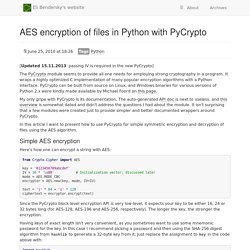
Random key generation; Key based encryption of a string; Installation. Install cryptography with pip: pip install cryptorgraphy. Supported Python versions. Python 2.7; Python 3.6; Python 3.7; Example Code for Python based symmetric encryption using AES-GCM and generation of keys.
| #!/usr/bin/env python |
| importbase64 |
| fromCryptoimportRandom |
| fromCrypto.CipherimportAES |
| BS=16 |
| pad=lambdas: s+ (BS-len(s) %BS) *chr(BS-len(s) %BS) |
| unpad=lambdas : s[0:-ord(s[-1])] |
| classAESCipher: |
| def__init__( self, key ): |
| self.key=key |
| defencrypt( self, raw ): |
| raw=pad(raw) |
| iv=Random.new().read( AES.block_size ) |
| cipher=AES.new( self.key, AES.MODE_CBC, iv ) |
| returnbase64.b64encode( iv+cipher.encrypt( raw ) ) |
| defdecrypt( self, enc ): |
| enc=base64.b64decode(enc) |
| iv=enc[:16] |
| cipher=AES.new(self.key, AES.MODE_CBC, iv ) |
| returnunpad(cipher.decrypt( enc[16:] )) |
| cipher=AESCipher('mysecretpassword') |
| encrypted=cipher.encrypt('Secret Message A') |
| decrypted=cipher.decrypt(encrypted) |
| printencrypted |
| printdecrypted |
commented Jan 13, 2014
AWESOMESAUCE. Sygic gps maps download for windows ce applications. |
commented Sep 16, 2016
This only works because the 'mysecretpassword' is 16 bytes. If it were a different (not dividable by 16) amount of bytes you'd get |
commented Dec 22, 2016
Cryptography In Python
Very minor changes to make it python 3 compatible https://gist.github.com/mguezuraga/257a662a51dcde53a267e838e4d387cd |
commented Dec 19, 2017 • edited
edited
lambda removed(pep 8 support) |
commented Jan 20, 2018 • edited
edited
In Python 3 using the modifications of Craz1k0ek it still doesn't work with Unicode. For example the input Edit: found a working version: https://stackoverflow.com/a/44212550 |
commented Apr 26, 2018
Python Cryptography Generate Aes Key For Windows 10
i think this is aes 128, we have a standard blocksize of 16 bytes (128bit) |
commented Apr 26, 2018
Public private key generation tools for windows 10. i can't seem to find how to do aes256 |
commented Jun 5, 2018
Python Cryptography Install
Please provide the JAVA code equivalent to above which is in python. |