Openssl Generate Seperate Private Key File
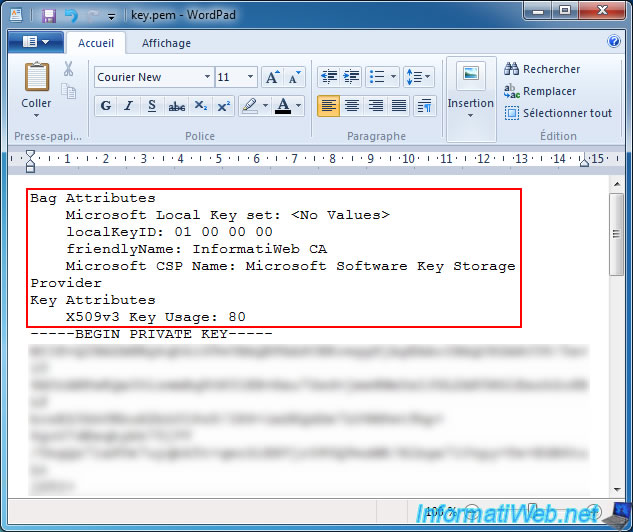
Fire up a command prompt and cd to the folder that contains your.pfx file. First type the first command to extract the private key: openssl pkcs12 -in yourfile.pfx -nocerts -out keyfile-encrypted.key What this command does is extract the private key from the.pfx file. Once entered you need to type in the importpassword of the.pfx file. OpenSSL: Working with SSL Certificates, Private Keys and CSRs OpenSSL is a versatile command line tool that can be used for a large variety of tasks related to Public Key Infrastructure (PKI) and HTTPS (HTTP over TLS). Sep 11, 2018 Use a text editor to open the file, and you will see the private key at the top of the list in the standard format:-BEGIN RSA PRIVATE KEY- (Encrypted Text Block) -END RSA PRIVATE KEY-Copy the private key, including the “BEGIN” and “END” tags, and paste it into a new text file. Save the text file as YourDomainName.key. How can I find the private key for my SSL certificate. If you just got an issued SSL certificate and are having a hard time finding the corresponding private key, this article can help you to find that one and only key for your certificate. For server.key, use openssl rsa in place of openssl x509. The server.key is likely your private key, and the.crt file is the returned, signed, x509 certificate. If this is for a Web server and you cannot specify loading a separate private and public key: You may need to concatenate the two files. Nov 09, 2019 In order to use below commands, you must have OpenSSL installed on your Windows or Linux system. Extract Private Key from PFX. The following command will extract the private key from the.pfx file. A new file private-key.pem will be created in current directory. This command required a password set on the pfx file. For server.key, use openssl rsa in place of openssl x509. The server.key is likely your private key, and the.crt file is the returned, signed, x509 certificate. If this is for a Web server and you cannot specify loading a separate private and public key: You may need to concatenate the two files. For this use.
Common OpenSSL Commands with Keys and Certificates
Generate RSA private key with certificate in a single command
Generate Certificate Signing Request (CSR) from private key with passphrase
Generate RSA private key (2048 bit)
Generate a Certificate Signing Request (CSR)
Generate RSA private key (2048 bit) and a Certificate Signing Request (CSR) with a single command
Convert private key to PEM format
Generate a self-signed certificate that is valid for a year with sha256 hash
View details of a RSA private key
View details of a CSR
View details of a Certificate
View details of a Certificate in DER format
Convert a DER file (.crt .cer .der) to PEM
Convert a PEM file to DER
genpkey - generate a private key
opensslgenpkey[-out filename][-outform PEM DER][-pass arg][-cipher][-engine id][-paramfile file][-algorithm alg][-pkeyopt opt:value][-genparam][-text]
The genpkey command generates a private key. https://Motorola-Ex115-Driver-Modem-Download.peatix.com/.
the output filename. If this argument is not specified then standard output isused.
This specifies the output format DER or PEM.
the output file password source. For more information about the format of argsee the PASS PHRASE ARGUMENTS section in openssl.
This option encrypts the private key with the supplied cipher. Any algorithmname accepted by EVP_get_cipherbyname() is acceptable such as des3.
specifying an engine (by its unique id string) will cause genpkeyto attempt to obtain a functional reference to the specified engine,thus initialising it if needed. The engine will then be set as the defaultfor all available algorithms. If used this option should precede all otheroptions.
public key algorithm to use such as RSA, DSA or DH. If used this option mustprecede any -pkeyopt options. The options -paramfile and -algorithmare mutually exclusive.
set the public key algorithm option opt to value. The precise set ofoptions supported depends on the public key algorithm used and itsimplementation. See KEY GENERATION OPTIONS below for more details.
generate a set of parameters instead of a private key. If used this option mustprecede and -algorithm, -paramfile or -pkeyopt options.
Some public key algorithms generate a private key based on a set of parameters.They can be supplied using this option. If this option is used the public keyalgorithm used is determined by the parameters. If used this option mustprecede and -pkeyopt options. The options -paramfile and -algorithmare mutually exclusive.
Print an (unencrypted) text representation of private and public keys andparameters along with the PEM or DER structure.
The options supported by each algorith and indeed each implementation of analgorithm can vary. The options for the OpenSSL implementations are detailedbelow.
Openssl Generate Separate Private Key File Format
The number of bits in the generated key. If not specified 1024 is used.
The RSA public exponent value. This can be a large decimal orhexadecimal value if preceded by 0x. Default value is 65537.
The number of bits in the generated parameters. If not specified 1024 is used.
The number of bits in the prime parameter p.
The value to use for the generator g.
Openssl Generate Separate Private Key File Pem File
If this option is set then the appropriate RFC5114 parameters are usedinstead of generating new parameters. The value num can take thevalues 1, 2 or 3 corresponding to RFC5114 DH parameters consisting of1024 bit group with 160 bit subgroup, 2048 bit group with 224 bit subgroupand 2048 bit group with 256 bit subgroup as mentioned in RFC5114 sections2.1, 2.2 and 2.3 respectively.
the EC curve to use.
Openssl Generate Separate Private Key File Pdf
Gost 2001 support is not enabled by default. To enable this algorithm,one should load the ccgost engine in the OpenSSL configuration file.See README.gost file in the engines/ccgost directiry of the sourcedistribution for more details.
Use of a parameter file for the GOST R 34.10 algorithm is optional.Parameters can be specified during key generation directly as well asduring generation of parameter file.
Specifies GOST R 34.10-2001 parameter set according to RFC 4357.Parameter set can be specified using abbreviated name, object short name ornumeric OID. Following parameter sets are supported:
The use of the genpkey program is encouraged over the algorithm specificutilities because additional algorithm options and ENGINE provided algorithmscan be used.
Generate an RSA private key using default parameters:
Encrypt output private key using 128 bit AES and the passphrase 'hello': Daz windows 7 key generator.
Generate Key With Openssl
Generate a 2048 bit RSA key using 3 as the public exponent:
Generate 1024 bit DSA parameters:
Generate DSA key from parameters:
Generate 1024 bit DH parameters:
Output RFC5114 2048 bit DH parameters with 224 bit subgroup:
Generate DH key from parameters: